What Is a Supply Chain Attack? How It Happens, Causes, Recent Cases, Challenges, and Prevention
On this page
Supply Chain Attacks Target Trust, Not Just Code
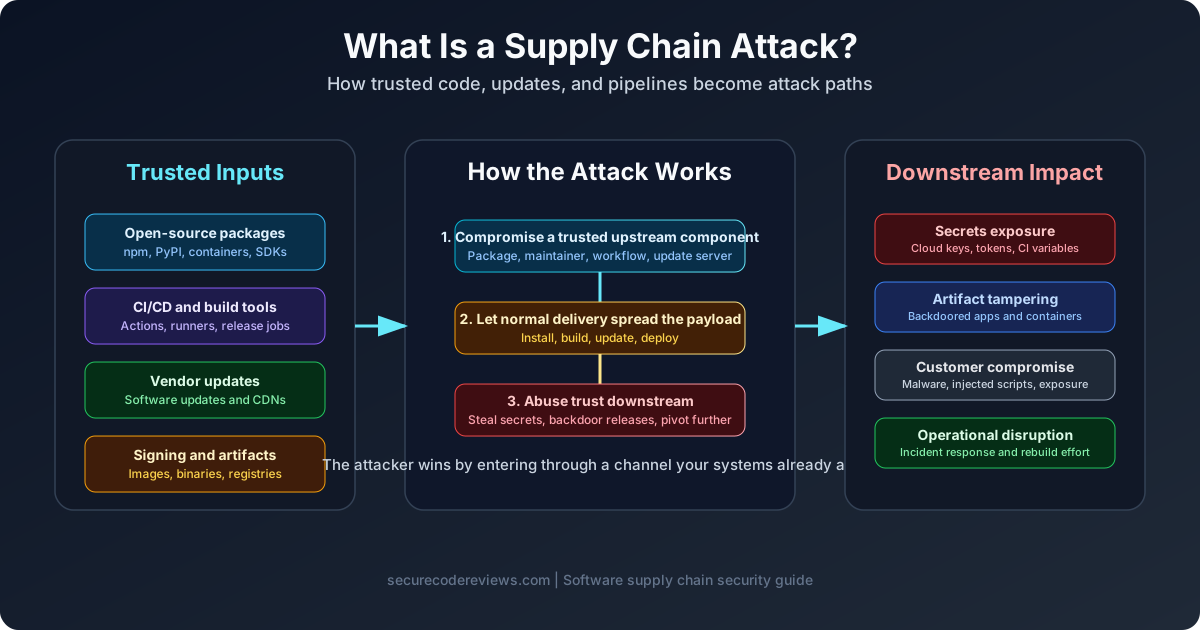
Most security teams are used to thinking about direct attacks: SQL injection, credential stuffing, exposed admin panels, or vulnerable APIs. Supply chain attacks work differently. The attacker does not always come straight at your application. Instead, they compromise something your application already trusts and let that trust do the delivery for them.
That trusted component might be a package from npm or PyPI, a GitHub Action, a build container, a software update server, a JavaScript CDN, a code-signing workflow, or even a maintainer account that publishes releases on your behalf.
This is why supply chain attacks are so dangerous. Once the malicious change enters a trusted dependency or delivery path, it can spread quietly into build systems, developer laptops, production workloads, and customer environments.
What Is a Supply Chain Attack?
A supply chain attack is a cyberattack in which an adversary compromises a trusted third-party component, service, or process in order to reach the final target.
In software, that usually means the attacker tampers with one of these layers:
- open-source packages and transitive dependencies
- internal libraries and artifact repositories
- CI/CD pipelines and build runners
- source code hosting or release automation
- update channels, package registries, and CDNs
- signing infrastructure, container images, or deployment artifacts
The key idea is simple: instead of breaking your front door, the attacker poisons something you routinely bring inside.
A simple example
Imagine a team installs a package that looks legitimate, or updates a GitHub Action pinned to a mutable tag. The package or action has been modified to steal environment variables. During CI, those variables include cloud credentials, API keys, or deployment tokens. The attacker never touched the production app directly, but they still gained a path into production.
That is the pattern repeated across many of the biggest supply chain incidents of the last few years.
How Supply Chain Attacks Happen
Most supply chain attacks follow a recognizable path. The details change, but the logic is consistent.
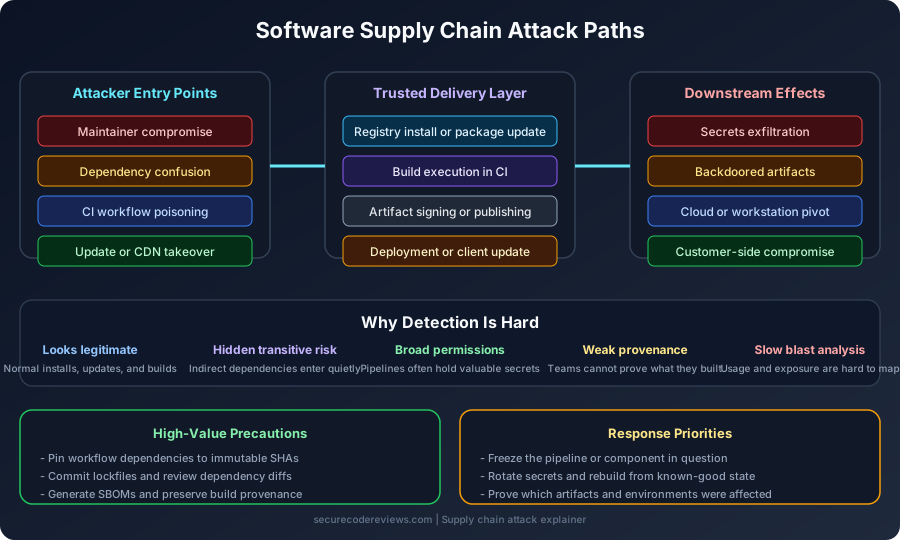
1. The attacker identifies a trust point
They look for the fastest path into many downstream environments at once. Common choices include:
- a widely used package
- a maintainer account with publish rights
- a CI workflow used by many repositories
- an update server or CDN that distributes code broadly
- an internal package naming convention that can be guessed
2. They compromise the trust point
This might happen through phishing, account takeover, social engineering, dependency confusion, malicious pull requests, registry abuse, or domain takeover.
3. The malicious change is delivered through normal operations
This is the part that makes defense hard. The code arrives through a process that normally looks legitimate:
- a developer runs
npm install - a nightly build pulls a dependency
- a CI runner executes a third-party action
- an endpoint downloads a signed or expected update
- a website loads a third-party script from a previously trusted domain
4. Trust bypasses suspicion
Because the source appears normal, traditional defenses may not flag it quickly. The package name looks right. The update channel is expected. The script is loaded from a domain that was already approved. The build succeeds. Everyone moves on.
5. The payload executes downstream
At that point the attacker may:
- exfiltrate secrets
- establish persistence
- tamper with artifacts
- inject backdoors
- steal customer data
- pivot into cloud environments or developer workstations
Common Types of Supply Chain Attacks
Dependency confusion
Dependency confusion happens when a build system installs an attacker-controlled public package instead of an internal private one with a similar name.
This usually works because registry priority or naming rules are misconfigured. Alex Birsan's 2021 research showed how effective this could be against major organizations.
Typosquatting
Attackers publish packages with names that look almost identical to legitimate ones. A rushed developer installs crossenv instead of cross-env, or request instead of a different intended package, and the malicious package enters the environment through a normal install.
Compromised maintainers
If an attacker gains access to a maintainer account, they do not need to create a fake package. They can publish a malicious version to the legitimate package directly. This is one reason maintainer security matters so much in open source.
CI/CD pipeline poisoning
Pipelines often have access to secrets, artifact registries, signing keys, and production deployment credentials. If an attacker compromises a runner, a shared workflow, or a third-party action, they can alter builds or steal secrets at scale.
Malicious or hijacked updates
In these cases the attacker compromises the software vendor, update mechanism, CDN, or associated infrastructure. Customers then pull the malicious update through a channel they already trust. SolarWinds is the best-known example.
Artifact and container tampering
Attackers may alter build artifacts after compilation, push poisoned container images, or replace release assets in a registry. If provenance is weak, teams may never notice that the artifact they deployed is not the artifact they built.
Domain or distribution takeover
Sometimes the package itself is not compromised at first. Instead, the attacker acquires or hijacks the domain or service used to distribute the code. The Polyfill.io incident showed how dangerous that can be when many websites load a script from the same domain.
Why Supply Chain Attacks Keep Working
Supply chain attacks succeed because modern software is built on layers of delegated trust.
Root cause 1: software is highly compositional
Most teams do not ship only their own code. They ship frameworks, libraries, containers, plugins, SaaS integrations, build actions, cloud images, and transitive dependencies they may never review manually.
Root cause 2: speed beats scrutiny
Engineering teams are rewarded for shipping, automating, and integrating quickly. That naturally creates pressure to trust defaults, accept updates, and reuse community tooling without deep verification.
Root cause 3: transitive risk is easy to miss
A team may carefully review first-party code and still miss what enters through five layers of indirect dependencies or build-time tooling.
Root cause 4: trust models are too broad
A single token, shared runner, mutable workflow tag, or over-privileged package publisher account can create a blast radius much larger than intended.
Root cause 5: provenance is still immature
Many organizations still cannot answer basic questions quickly:
- What exact components are in this release?
- Where did this artifact come from?
- Was the build reproducible?
- Who approved the change?
- Did the deployed binary match the reviewed source?
If those questions are hard to answer during normal operations, they become even harder during an incident.
Challenges in Defending Against Supply Chain Attacks
Even mature teams struggle here because the problem is not only about patching vulnerabilities.
Limited visibility
You cannot secure what you cannot inventory. Many teams still lack high-quality SBOMs, dependency lineage, or reliable artifact provenance.
Shared responsibility without clear ownership
Supply chain security crosses AppSec, platform engineering, DevOps, procurement, IT, and developers. That often means everybody touches it and nobody fully owns it.
False sense of legitimacy
Malicious packages, updates, or actions often arrive through familiar channels. The more routine the workflow looks, the easier it is to miss.
Alert fatigue
Dependency scanning tools can generate large volumes of findings, many of which are not urgent. Teams drown in vulnerability noise and miss integrity problems that require immediate action.
Long-lived trust relationships
A package added years ago or an action pinned to a tag months ago can quietly become risky later. Supply chain risk is not fixed at the time of adoption.
Difficult blast-radius analysis
When an incident breaks, teams need to know where a compromised component was used, which secrets were exposed, and which artifacts were built from it. Without good metadata, that analysis is slow and painful.
Recent Supply Chain Attacks and What They Teach
The names differ, but the lessons repeat.
| Incident | Year | What happened | Main lesson |
|---|---|---|---|
| SolarWinds Sunburst | 2020 | Attackers inserted malware into a trusted software update process | Trusted updates can become mass-delivery channels |
| Codecov Bash Uploader | 2021 | Attackers modified a script to exfiltrate CI secrets from customer environments | CI tooling deserves the same scrutiny as production code |
| ua-parser-js | 2021 | Malicious package versions delivered credential stealers and crypto miners | Even common utility packages can become distribution vehicles |
| PyTorch nightly | 2022 | Dependency confusion exposed a path to malicious package installation | Internal package naming and registry precedence matter |
| 3CX desktop software compromise | 2023 | A trusted vendor application was used as a downstream compromise vector | Third-party desktop and endpoint software is part of the supply chain too |
| xz Utils backdoor attempt | 2024 | Multi-year social engineering targeted a critical maintainer path | Human trust and maintainer fatigue are part of the attack surface |
| Polyfill.io domain takeover abuse | 2024 | Previously trusted script delivery infrastructure served malicious behavior | External JavaScript dependencies create hidden concentration risk |
The xz Utils lesson
The xz case is especially important because it was not a smash-and-grab package compromise. It showed patience, social engineering, and the value attackers place on trusted maintainers. That is a warning sign for every organization that relies on critical open-source components maintained by a very small number of people.
The Polyfill.io lesson
Many teams focus on backend dependencies and forget that frontend script supply chains are still supply chains. If your pages pull code from third-party domains, that trust can be abused just as easily as a package registry can.
Precautions That Actually Reduce Risk
There is no single control that solves supply chain security. The goal is to reduce blind trust and make tampering easier to detect.
1. Pin what you run
- commit lockfiles and review lockfile diffs carefully
- use
npm cior equivalent deterministic installs in CI - pin GitHub Actions and similar workflow dependencies to immutable SHAs
- avoid floating tags and unreviewed auto-upgrades for sensitive components
2. Shrink dependency sprawl
- remove unused packages regularly
- challenge every new dependency during review
- prefer mature, actively maintained packages over obscure ones with weak stewardship
- treat build-time dependencies as security-relevant, not just runtime dependencies
3. Use private registries and namespace controls
- host internal packages in a private registry
- configure scoped packages explicitly
- reserve internal names where possible
- block or review public packages that overlap with internal naming patterns
4. Generate SBOMs and track provenance
Teams need a reliable record of what went into each release. Generate SBOMs during build and keep them attached to release artifacts. Use provenance attestations and signing where practical so you can verify the lineage of what you deploy.
5. Harden CI/CD aggressively
- isolate runners when possible
- limit environment variable exposure by job and step
- reduce token lifetime and scope
- separate build, test, signing, and deployment privileges
- protect release workflows with stronger review gates
6. Verify more than vulnerability status
Known CVEs matter, but integrity signals matter too. Review package behavior, maintainer changes, suspicious install scripts, unusual network calls, and unexpected post-install execution.
7. Watch third-party scripts and vendor dependencies
Inventory browser-side scripts, analytics tags, customer support widgets, mobile SDKs, desktop agents, and deployment-side tools. The supply chain is broader than package.json.
8. Prepare an incident workflow before you need it
If a package, vendor, or workflow is compromised tomorrow, teams should already know how to search usage, freeze releases, rotate secrets, rebuild artifacts, and communicate impact.
A Practical Team Checklist
For developers
- verify package names before installation
- do not bypass lockfiles to "make CI pass"
- review install scripts and dependency changes like real code changes
- avoid pulling scripts directly from unknown external URLs in build pipelines
For DevOps and platform teams
- pin workflow dependencies to SHAs
- isolate runners and minimize secret exposure
- generate SBOMs on every release build
- enforce artifact retention and provenance records
For AppSec teams
- combine vulnerability scanning with integrity-focused review
- map critical applications to their most sensitive upstream dependencies
- maintain playbooks for dependency compromise and build pipeline abuse
- pressure-test response time with tabletop exercises
For leadership
- assign clear ownership for software supply chain security
- fund dependency hygiene and build-system hardening, not just perimeter tools
- treat key open-source dependencies as business-critical infrastructure
What To Do If You Suspect a Supply Chain Compromise
- stop further deployment from the suspected component or pipeline
- identify affected applications, artifacts, and environments
- rotate secrets that may have been exposed during builds or runtime
- rebuild from a known-good state rather than trusting existing artifacts
- search logs and telemetry for signs of follow-on activity
- document blast radius, timeline, and customer impact quickly
- update controls so the same trust path cannot be abused again
Fast containment matters, but trustworthy reconstruction matters just as much. In many supply chain incidents, the hard part is not finding the vulnerable package. It is proving which outputs are still safe.
Frequently Asked Questions
Is Log4Shell a supply chain attack?
Log4Shell is best understood as a dependency-related vulnerability with supply chain impact. It was not primarily a hidden tampering case like SolarWinds or xz, but it spread through the software supply chain because so many products inherited the vulnerable component.
Are supply chain attacks only about open source?
No. Open source is a major part of the story, but vendors, CI providers, browser-side scripts, mobile SDKs, update channels, container registries, and internal build systems are all part of the software supply chain.
What is the first control most teams should implement?
For many teams the first practical win is deterministic builds: committed lockfiles, pinned workflow dependencies, and stricter CI handling of secrets. That does not solve everything, but it removes a lot of easy failure modes.
Do SBOMs solve supply chain security?
SBOMs help with visibility, which is essential, but they are not a complete defense. You also need provenance, build hardening, identity controls, monitoring, and a response process for compromised components.
Final Takeaway
The core problem behind supply chain attacks is not simply vulnerable code. It is unexamined trust. Modern software teams inherit enormous amounts of trust every time they install a package, run a workflow, pull a container, or accept an update.
The organizations that handle this well do not try to eliminate all third-party risk. They make trust narrower, more explicit, and easier to verify. That is the real shift: from assuming the supply chain is safe to continuously proving that what you build and ship is what you intended.
Further Reading
- Software Supply Chain Security: OWASP A03, SBOM, and the Fight Against Dependency Attacks
- OWASP Top 10 2025
- SLSA Framework
- OpenSSF Scorecard
- NIST Secure Software Development Framework (SP 800-218)
- Sonatype, State of the Software Supply Chain
- CISA guidance on secure-by-design software supply chains
Published by SecureCodeReviews
This article is part of our original AI security and cybersecurity content library. We show publish and update dates, keep company and policy pages public, and update important guidance when material changes affect readers.
Planning an AI feature launch or security review?
We assess prompt injection paths, data leakage, tool use, access control, and unsafe AI workflows before they become production problems.
Advertisement
Free Security Tools
Try our tools now
Expert Services
Get professional help
OWASP Top 10
Learn the top risks
Related Articles
Container Security Best Practices for Production
Secure your containerized applications from image building to runtime with these battle-tested practices.
DevSecOps: The Complete Guide 2025-2026
Master DevSecOps with comprehensive practices, automation strategies, real-world examples, and the latest trends shaping secure development in 2025.
Software Supply Chain Security: OWASP A03, SBOM, and the Fight Against Dependency Attacks
Supply chain attacks surged 742% since 2019 (Sonatype). This OWASP A03 deep dive covers dependency confusion, typosquatting, CI/CD poisoning, SBOMs, SLSA frameworks, and lockfile security with actionable prevention strategies.