What Is Agentic AI? Security Risks, Use Cases, Challenges, and Future
On this page
Agentic AI Is the Shift From Answering Questions to Taking Actions
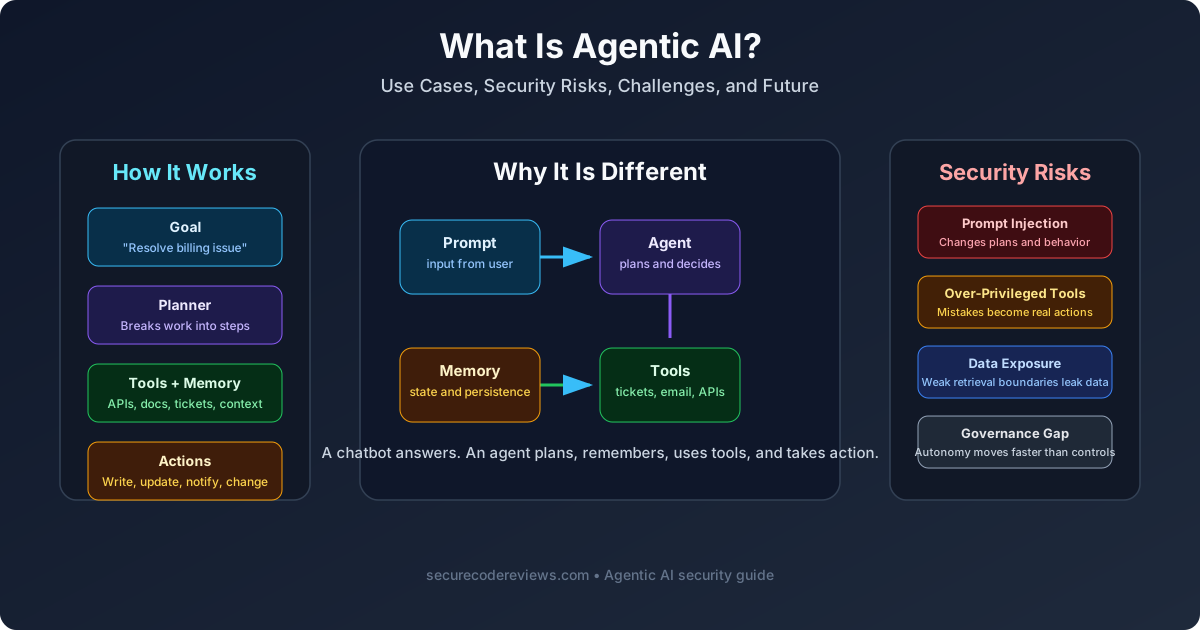
Most people first met AI through chat interfaces: ask a question, get a response, move on. Agentic AI changes that model. Instead of stopping at an answer, the system plans, decides, uses tools, stores context, and carries out multi-step work.
That is why agentic AI feels so powerful. It is also why it creates a much bigger security problem than a normal chatbot.
An ordinary LLM can be wrong, misleading, or vulnerable to prompt injection. An agentic AI system can be all of those things and still have access to email, internal APIs, cloud consoles, ticketing systems, code repositories, or financial workflows. Once autonomy and tool use enter the picture, the blast radius changes.
This is the real reason security teams are paying attention. Agentic AI is not just another interface trend. It is a new operational layer that sits between humans and business systems.
What Is Agentic AI?
At a high level, agentic AI refers to AI systems that are given goals instead of only prompts, and can autonomously decide how to achieve those goals using tools, memory, and multi-step reasoning.
OWASP describes an agentic AI application as a system in which an AI model is given goals and can autonomously plan and execute multi-step actions using external tools and data sources with varying degrees of human oversight. That definition matters because it highlights the two things that make agentic AI different:
- the system has a goal, not just a request
- the system can act on the world, not just describe it
That may sound subtle, but it changes everything.
How Agentic AI Actually Works
Most agentic AI systems are made of several layers working together:
1. The planner
This is the component that breaks a goal into steps. If the goal is "prepare a weekly security summary," the planner may decide to gather tickets, pull cloud alerts, summarize incidents, and draft follow-up actions.
2. The memory layer
The system stores working context, prior steps, user preferences, and sometimes long-term notes. This is useful for continuity, but it also creates persistence risk.
3. The tool layer
This is where the agent connects to the real world: databases, APIs, SaaS products, shell commands, ticketing systems, search tools, or internal workflows.
4. The evaluator or feedback loop
Many agentic systems check their own progress, retry failed steps, or ask a secondary model to judge whether a result is good enough.
5. The action layer
The system writes the ticket, sends the message, updates the record, opens the pull request, or triggers the next workflow.
That is why a practical mental model for agentic AI is not "smart chatbot." It is "software worker with model-driven decision making."
How Agentic AI Differs From a Normal LLM Application
| Dimension | Traditional LLM app | Agentic AI |
|---|---|---|
| Interaction style | One prompt, one response | Multi-step planning and execution |
| Memory | Often session-based | Frequently persistent and operational |
| Tool use | Limited or optional | Core part of the system |
| Failure mode | Wrong answer | Wrong action, data exposure, or workflow abuse |
| Security impact | Mostly output risk | Output risk plus identity, tools, and autonomy |
That last row is the one security leaders care about. The problem is no longer just content safety. It becomes application security, identity security, API security, and operational resilience at the same time.
Real Use Cases for Agentic AI
Customer support operations
An agent reviews prior tickets, finds related documentation, drafts an answer, and creates a follow-up task if the issue looks like a bug.
Value: faster support response times and more consistent triage.
Risk: if retrieval boundaries are weak, the agent may summarize another customer's data or trigger unauthorized credits and refunds.
Security operations
A SOC assistant collects alerts, correlates endpoint and cloud telemetry, suggests triage, enriches indicators, and drafts incident notes.
Value: less analyst fatigue and faster first-pass investigation.
Risk: a poisoned alert source or manipulated ticket can influence prioritization, create false confidence, or cause the agent to take the wrong containment step.
Software engineering
An engineering agent reads the backlog, proposes code changes, opens pull requests, runs tests, and writes release notes.
Value: reduced toil for repetitive engineering work.
Risk: if the agent can access repositories, secrets, or CI systems, prompt injection or unsafe tool use can turn into code compromise.
Cloud and platform operations
An operations agent monitors cost anomalies, inspects logs, recommends fixes, and applies low-risk infrastructure changes.
Value: faster response to noisy, repetitive operational events.
Risk: over-broad permissions and insufficient approval gates can turn a simple mistake into a production outage.
Internal knowledge work
An agent searches documents, summarizes policy, drafts meeting briefs, and coordinates tasks across email, chat, and tickets.
Value: real productivity gains for internal teams.
Risk: the assistant becomes a new path for data leakage, shadow access, and policy hallucination.
Why Agentic AI Is Harder to Secure
1. Prompt injection becomes an action problem
In a basic chatbot, prompt injection may cause a bad answer. In an agentic system, the same manipulation can influence a plan, change tool selection, or trigger a harmful step.
That is the shift: text manipulation becomes workflow manipulation.
2. Goal drift is subtle
Agents can gradually move away from the original intent while still appearing helpful. A system tasked with "resolve this billing issue" might quietly start optimizing for ticket closure rather than correctness or authorization.
3. Tool access amplifies every mistake
The model does not need to be perfect to be dangerous. It only needs enough confidence to call the wrong tool, pass unsafe arguments, or act without approval.
4. Identity is no longer just for humans
Agentic systems need machine identities, scoped credentials, delegation limits, and audit trails. Traditional IAM was not designed for thousands of semi-autonomous actions per hour.
5. Memory introduces persistence risk
If an agent stores poisoned instructions, unsafe preferences, or sensitive artifacts in long-term memory, a one-time bad interaction can influence future runs.
6. Multi-agent systems create cascading failure
Once agents call other agents, trust and failure propagate. One compromised or misconfigured component can contaminate multiple downstream workflows.
The Main Security Challenges in Agentic AI
Uncontrolled autonomy
The more freedom an agent has, the harder it is to predict its failure modes. Teams often overestimate how safe an agent is because it performed well in demos.
Weak authorization around retrieval and tools
Many agentic systems retrieve data globally and filter late, or assume that if a user was authenticated once, every later tool call is safe. That is where cross-tenant leakage and business logic abuse start.
Unsafe output handling
An agent may generate code, markdown, commands, summaries, or tickets that are later rendered or executed by another system. If output is trusted by default, the agent becomes an injection broker.
Opaque reasoning and limited auditability
When something goes wrong, teams need to know:
- what the goal was
- which context the agent used
- why it chose a tool
- what data it touched
- what action it took
If those answers are missing, the system is operationally fragile even before regulators get involved.
Governance lag
Many organizations adopt agentic AI before they define policies for approval, retention, incident response, human oversight, or data classification. The technology moves faster than the control model.
A Representative Failure Scenario
Consider a finance support agent that can read invoices, search policy docs, and create credit requests.
The intended workflow looks efficient:
- user asks why an invoice looks wrong
- agent retrieves account history
- agent compares policy and prior adjustments
- agent drafts a resolution
- agent creates a credit request for approval
Now add one mistake: the retrieval layer is not scoped correctly.
The agent pulls invoices from multiple customers with similar names. It drafts a confident answer using the wrong account history and creates a high-value credit request with incorrect reasoning.
Nothing about that failure requires a Hollywood-style hack. It is just a normal application control weakness made faster and harder to spot by autonomy.
What Secure Agentic AI Deployment Looks Like
Start with narrow scope
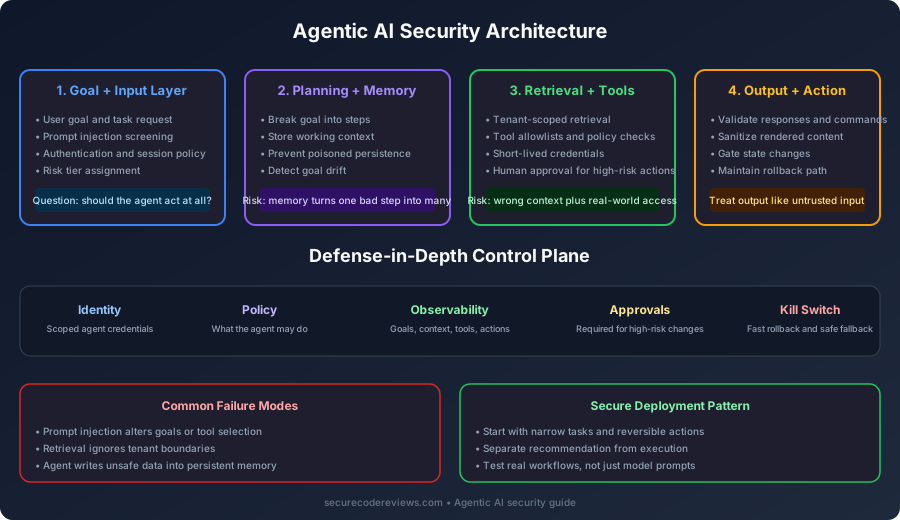
The safest early agents operate in constrained domains with limited tools and reversible actions.
Separate recommendation from execution
For higher-risk workflows, let the agent suggest the next step but require deterministic approval before the action runs.
Enforce authorization before context reaches the model
Retrieval should be filtered by user, tenant, project, and data sensitivity before ranking and summarization.
Give each agent a scoped identity
Short-lived credentials, explicit tool permissions, and delegation boundaries should be standard, not optional.
Treat output as untrusted
Summaries, code, commands, and generated actions all need validation or approval depending on risk.
Log the full decision path
You need observable execution trails for debugging, incident response, and compliance review.
Add kill switches and fallback modes
If the agent behaves strangely, fails open, or loses safety controls, operators need a fast way to shut down automation and degrade safely to human handling.
The Future of Agentic AI
The future is probably not one giant agent doing everything. It is more likely a set of narrower agents with clearer scopes, stronger policy enforcement, and better runtime controls.
Several trends are already becoming visible:
More specialized agents
Organizations are moving away from general-purpose autonomous assistants toward domain-specific agents for security, support, finance, and engineering.
More runtime governance
Policy engines, approval gates, tool-level authorization, and observability will become part of the default architecture instead of security add-ons.
More machine identity work
As agents proliferate, identity and access management for non-human actors will become central to enterprise security design.
More compliance pressure
Regulators and auditors will not care that an error came from an "AI agent." They will care whether the organization had oversight, documentation, access control, and incident handling.
More evaluation of behavior, not just model quality
Teams will spend less time asking whether the model is impressive and more time asking whether the workflow is bounded, observable, and safe.
Agentic AI Security Checklist
- Define where the agent is allowed to act and where it must stop.
- Scope retrieval by tenant, user, and sensitivity before context is assembled.
- Give each agent its own identity and short-lived credentials.
- Keep write actions and destructive tools behind explicit approval gates.
- Treat memory as an untrusted persistence layer, not a convenience feature.
- Validate generated output before rendering, storing, or executing it.
- Log goals, context, tool calls, decisions, and outcomes.
- Red-team the real workflow, not just the base model prompt.
- Maintain a kill switch and a safe fallback mode.
Further Reading
- OWASP Top 10 for Agentic AI - Official OWASP guidance for agentic systems
- NIST AI Risk Management Framework - Risk management principles for AI systems
- MITRE ATLAS - Adversarial tactics and techniques for AI systems
- Google Secure AI Framework - Security design principles for AI deployments
- Anthropic: Building Effective Agents - Practical engineering guidance for agent systems
Related SecureCodeReviews guides:
- OWASP Top 10 for Agentic AI 2026: Complete Security Guide
- How to Secure AI Agents: Identity and Access Management for Agentic AI
- Secure Tool Calling for LLMs: Function Calling Risks and Runtime Controls
- AI Governance Framework 2026: Building Guardrails for Enterprise AI
If you strip away the hype, the most useful way to think about agentic AI is this: it is software with judgment, memory, and access. That combination can create real value. It can also create a new class of failures. The organizations that benefit most will not be the ones that give agents the most freedom. They will be the ones that give agents the clearest boundaries.
Published by SecureCodeReviews
This article is part of our original AI security and cybersecurity content library. We show publish and update dates, keep company and policy pages public, and update important guidance when material changes affect readers.
Planning an AI feature launch or security review?
We assess prompt injection paths, data leakage, tool use, access control, and unsafe AI workflows before they become production problems.
Advertisement
Free Security Tools
Try our tools now
Expert Services
Get professional help
OWASP Top 10
Learn the top risks
Related Articles
AI Security: Complete Guide to LLM Vulnerabilities, Attacks & Defense Strategies 2025
Master AI and LLM security with comprehensive coverage of prompt injection, jailbreaks, adversarial attacks, data poisoning, model extraction, and enterprise-grade defense strategies for ChatGPT, Claude, and LLaMA.
AI Security & LLM Threats: Prompt Injection, Data Poisoning & Beyond
A comprehensive analysis of AI/ML security risks including prompt injection, training data poisoning, model theft, and the OWASP Top 10 for LLM Applications. With practical defenses and real-world examples.
AI Red Teaming: How to Break LLMs Before Attackers Do
A practical guide to AI red teaming — adversarial testing of LLMs, prompt injection techniques, jailbreaking methodologies, and building an AI security testing program.